
Can Mica Powder be used in Resin?
If you are like most crafters out there who are getting started with mediums like epoxy resin, you might wonder if Mica Powder can be used to color your projects and creations. Here is the answer to that question:
Yes, mica powder can be used to color epoxy resin and create shimmer and pearlescent effects. Particle movement and settling depend on the pigment, resin viscosity, working time, and curing conditions.
Mica generally disperses as solid particles rather than dissolving in resin. Compatibility depends on the exact pigment, resin, and pigment load. Follow the resin manufacturer’s instructions and additive limits, and test a small batch through the full cure before starting a larger project.
So that’s why Mica powder is one of the most popular choices for artists and enthusiasts who want to make the finest resin art. But you’re probably wondering now how to use Mica Powders to color Epoxy Resin.
How to use Mica Powder in Resin
Since Micas are highly pigmented mineral powders, a tiny bit will usually go a long way when it comes to adding color and pearlescent effects to resin art projects like jewelry, resin coasters, or even small resin geodes and paintings. For epoxy resin river tables and larger resin casting projects, a more significant pigment load will be needed but still not a lot. The most important thing is understanding how much pigment you need depending on the type of project and the desired outcome.
How much Mica Powder to add to Epoxy?
Small Epoxy Resin Projects
For a vibrant, opaque effect with MEYSPRING mica powders in epoxy resin, our general starting range is 1% to 3.5% pigment by the total weight of mixed Part A plus Part B. For example, 100g of mixed epoxy uses 1g to 3.5g of mica powder within that range. The result depends on the color, resin, and pour depth. Follow your resin manufacturer’s additive limit if it is lower and test through the full cure. Loads above 4% can affect curing in some resins; 4% is not a universal safe limit. This mica guidance is not a confirmed dose for every True Metallics or glitter product. One ounce by weight equals 28.35g; 1g mica per ounce by weight of mixed epoxy is approximately 3.5%. Fluid ounces measure volume and are not interchangeable with ounces by weight.
Larger Epoxy Resin Projects
For a vibrant, opaque effect with MEYSPRING mica powders in epoxy resin, our general starting range is 1% to 3.5% pigment by the total weight of mixed Part A plus Part B. For example, 100g of mixed epoxy uses 1g to 3.5g of mica powder within that range. The result depends on the color, resin, and pour depth. Follow your resin manufacturer’s additive limit if it is lower and test through the full cure. Loads above 4% can affect curing in some resins; 4% is not a universal safe limit. This mica guidance is not a confirmed dose for every True Metallics or glitter product.
River Tables or Resin & Wood Projects
The amount depends on the exact mica color, desired transparency, resin, and pour depth. There is no universal teaspoon-per-gallon dose: spoonfuls of different pigments can have different weights. For a translucent river, test small measured amounts until you get the desired effect. For an opaque mica effect, the general starting range is 1% to 3.5% of the total mixed Part A plus Part B weight, subject to the resin manufacturer’s lower additive limit. Keep a record of your test ratio, check the full cure, and scale by weight. Do not convert liters or gallons to resin mass without measured weight or the applicable resin density.
Watch the artists @pinesandneedle below mixing our Imperial Emerald Intense Chroma Mica Powder pigment into Epoxy Resin for a beautiful woodworking project:
When to add Mica Powder to Resin?
High-quality Mica Powders have the perfect particle size to blend into epoxy resin fairly easily. So once your resin (usually called by manufactures "Part A") and hardener (also know as "Part B") are thoroughly mixed, you can add mica powder and stir until fully incorporated.
Some crafters like to pre-mix mica powders with the "Part A" of epoxy resin first because this allows the powder particles to be fully dispersed before adding the color to a more significant amount of resin. But this is not necessary when using high-quality mica powders, because they can be added directly to a large batch of resin.
Final Thought
Mica powder can create shimmery resin art with different levels of transparency. Use measured mixed Part A plus Part B weight for dosage, follow the resin maker’s instructions, and test the exact pigment through the full cure. A pigment can affect the resin system, so do not assume that adding it leaves every property unchanged.
If you are curious about simple resin art techniques to create mind-blowing special effects using MEYSPRING mica powders, check this article here and watch what’s possible.
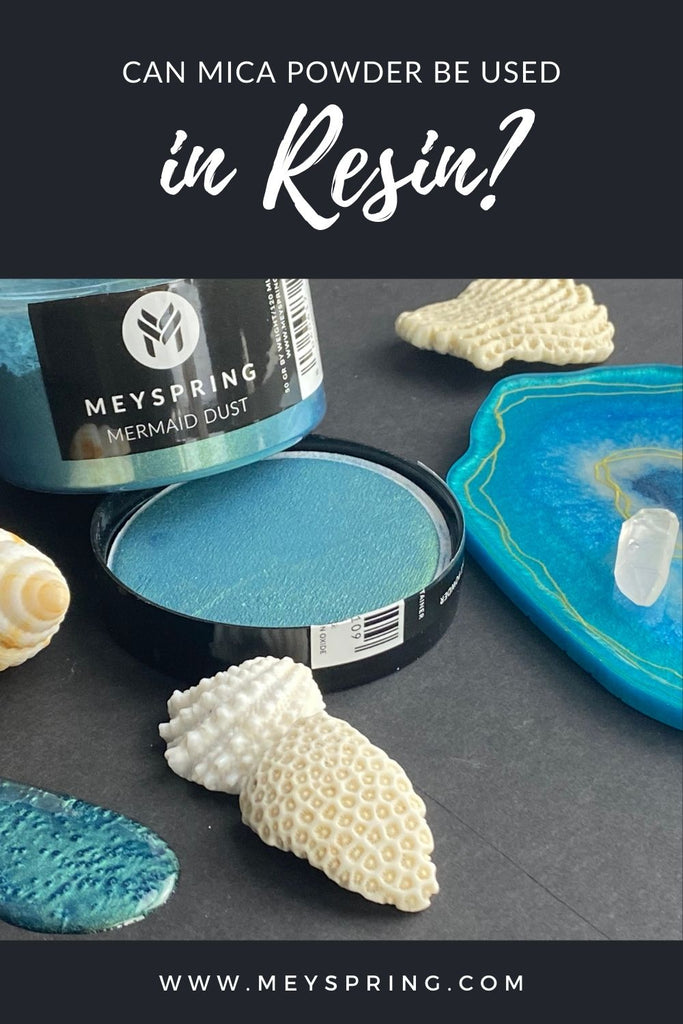
Below is a Pinterest friendly photo you can save on your boards for reference.
2 comments
@erik, in the US, there isn’t an easy way to measure a 28th of an ounce, but most kitchen scales here can measure both oz and grams. We don’t use metric often here, but do use ml and grams when needing small amounts because you can generally find tools to measure that.
Nice article but going out of your way to mention both metric and imperial is just weird and confusing, 1 gr to 1 ounce, really ? How about 1 gram to 28.35 gram or 28th of an ounce to 1 ounce ? Weird, I know both imperial and metric system as my work required but as an European man it’s annoying this imperial charade, but it get’s worse when people start mixing it left and right between the two, this is small things but imagine projects that are about 100.000 times more complex and having both metric system, ughhhh.