

Can Mica Powder be used in Resin?
In this article
If you are like most crafters out there who are getting started with mediums like epoxy resin, you might wonder if Mica Powder can be used to color your projects and creations. Here is the answer to that question:
Yes, mica powder can be used to color epoxy resin and create shimmer and pearlescent effects. Particle movement and settling depend on the pigment, resin viscosity, working time, and curing conditions.
Mica generally disperses as solid particles rather than dissolving in resin. Compatibility depends on the exact pigment, resin, and pigment load. Follow the resin manufacturer’s instructions and additive limits, and test a small batch through the full cure before starting a larger project.
So that’s why Mica powder is one of the most popular choices for artists and enthusiasts who want to make the finest resin art. But you’re probably wondering now how to use Mica Powders to color Epoxy Resin.
How to use Mica Powder in Resin
Since Micas are highly pigmented mineral powders, a tiny bit will usually go a long way when it comes to adding color and pearlescent effects to resin art projects like jewelry, resin coasters, or even small resin geodes and paintings. For epoxy resin river tables and larger resin casting projects, a more significant pigment load will be needed but still not a lot. The most important thing is understanding how much pigment you need depending on the type of project and the desired outcome.
How much Mica Powder to add to Epoxy?
Small Epoxy Resin Projects
MEYSPRING mica powders are highly pigmented, so a little bit goes a long way. The amount needed depends on the color, desired opacity and resin layer thickness. Start with a little bit of pigment and add gradually until the desired opacity is reached. Color and resin layer thickness might affect the end result. Keep mica at or below 3% of the combined resin + hardener weight (Part A + Part B), or your resin maker’s lower limit. Too much pigment can interfere with curing. Use our mica calculator for approximate spoon amounts. Follow your resin maker’s mixing instructions and keep the Part A-to-Part B ratio unchanged. Test a small batch through the full cure before scaling up.
Larger Epoxy Resin Projects
Thin crafts and deep river-table pours can need different amounts of mica for the same apparent opacity. A thicker resin layer may appear opaque with less pigment per fluid ounce. Batch size alone does not determine the amount needed. Keep mica at or below 3% of the combined resin + hardener weight (Part A + Part B), or your resin maker’s lower limit. Too much pigment can interfere with curing. Use our mica calculator for approximate spoon amounts. Follow your resin maker’s mixing instructions and keep the Part A-to-Part B ratio unchanged. Test a small batch through the full cure before scaling up.
River Tables or Resin & Wood Projects
Thin crafts and deep river-table pours can need different amounts of mica for the same apparent opacity. A thicker resin layer may appear opaque with less pigment per fluid ounce. Batch size alone does not determine the amount needed. Start with a little bit of pigment and add gradually until the desired opacity is reached. Color and resin layer thickness might affect the end result. Keep mica at or below 3% of the combined resin + hardener weight (Part A + Part B), or your resin maker’s lower limit. Too much pigment can interfere with curing.
Watch the artists @pinesandneedle below mixing our Imperial Emerald Intense Chroma Mica Powder pigment into Epoxy Resin for a beautiful woodworking project:
When to add Mica Powder to Resin?
High-quality Mica Powders have the perfect particle size to blend into epoxy resin fairly easily. So once your resin (usually called by manufactures "Part A") and hardener (also know as "Part B") are thoroughly mixed, you can add mica powder and stir until fully incorporated.
Some crafters like to pre-mix mica powders with the "Part A" of epoxy resin first because this allows the powder particles to be fully dispersed before adding the color to a more significant amount of resin. But this is not necessary when using high-quality mica powders, because they can be added directly to a large batch of resin.
Final Thought
Mica powder can create shimmery resin art with different levels of transparency. Use measured mixed Part A plus Part B weight for dosage, follow the resin maker’s instructions, and test the exact pigment through the full cure. A pigment can affect the resin system, so do not assume that adding it leaves every property unchanged.
If you are curious about simple resin art techniques to create mind-blowing special effects using MEYSPRING mica powders, check this article here and watch what’s possible.
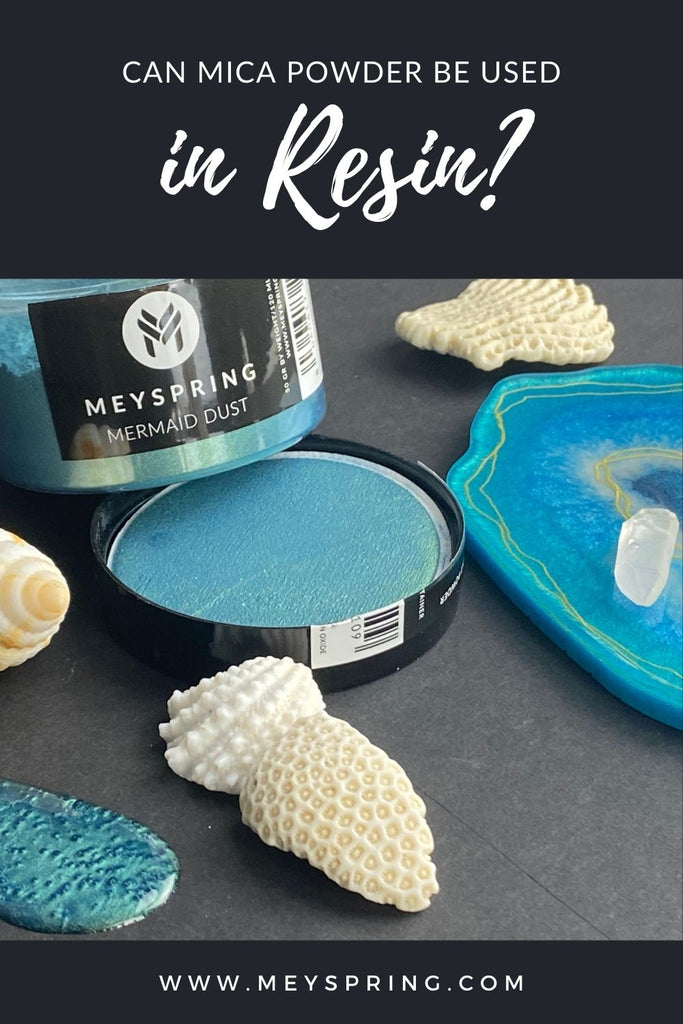
Below is a Pinterest friendly photo you can save on your boards for reference.


2 comments
@erik, in the US, there isn’t an easy way to measure a 28th of an ounce, but most kitchen scales here can measure both oz and grams. We don’t use metric often here, but do use ml and grams when needing small amounts because you can generally find tools to measure that.
Nice article but going out of your way to mention both metric and imperial is just weird and confusing, 1 gr to 1 ounce, really ? How about 1 gram to 28.35 gram or 28th of an ounce to 1 ounce ? Weird, I know both imperial and metric system as my work required but as an European man it’s annoying this imperial charade, but it get’s worse when people start mixing it left and right between the two, this is small things but imagine projects that are about 100.000 times more complex and having both metric system, ughhhh.